
Olympus XA2 Manual: A Comprehensive Guide
This guide offers detailed instructions for the Olympus XA2, covering operation, features, and troubleshooting, with PDF manual access available online.
The Olympus XA2, a compact 35mm rangefinder camera, gained popularity for its sleek design and impressive image quality. Released as a successor to the original XA, it offered enhanced features and usability. This camera appeals to both enthusiasts and casual photographers seeking a portable and capable system.

Finding the Olympus XA2 instruction manual is crucial for understanding its functions. Online resources, including websites like orphan cameras, provide free PDF manuals. Mastering the XA2 involves familiarizing yourself with its unique controls and capabilities, ensuring optimal photographic results.
Key Features and Specifications
The Olympus XA2 boasts a sharp 35mm f/2.8 lens, delivering excellent image clarity. Its key features include aperture priority exposure, a reliable spot metering system, and a built-in flash. The camera accepts 35mm film, offering versatility for various photographic styles.
Specifications include a shutter speed range of 2 to 500 seconds. Accessing the Olympus XA2 manual reveals detailed information about these features. Its compact size and lightweight design enhance portability, making it ideal for street photography and travel.
Understanding the Camera Body
The Olympus XA2’s body is renowned for its sleek, clamshell design, protecting the lens when closed. This compact form factor belies its robust functionality. The Olympus XA2 manual details each component. Controls are intuitively placed for easy access, even during quick shooting scenarios.
The body houses the film compartment, shutter release, and exposure settings. Familiarizing yourself with the layout, as described in the user guide, is crucial for optimal operation and enjoying this classic camera’s capabilities.
Layout of Controls
The XA2’s controls are minimalist yet functional. The shutter release is prominently positioned for comfortable operation. Aperture settings are adjusted via a surrounding ring around the lens. Exposure compensation is managed with a dedicated dial. The film advance lever and rewind crank are standard.
Referencing the Olympus XA2 manual clarifies each control’s purpose. The compact design necessitates a streamlined layout, prioritizing ease of use without sacrificing functionality. Understanding this arrangement enhances shooting efficiency.
Film Loading and Unloading
Loading film into the Olympus XA2 involves opening the camera back via a latch. Secure the film canister, thread the leader to the take-up spool, and advance a few frames. Unloading requires releasing the film rewind crank and gently winding the film back into the canister.
Consult the XA2 manual for detailed diagrams. Proper film handling prevents damage and ensures optimal performance. Always unload film in subdued light to avoid accidental exposure.
Using the Lens
The Olympus XA2 features a high-quality 35mm f/2.8 lens. This lens delivers sharp images with pleasing bokeh. Focusing is achieved through a zone focusing system, selecting distance settings for optimal sharpness.

Understanding the lens characteristics is crucial for achieving desired results. Refer to the XA2 manual for detailed information on aperture control and depth of field considerations for various shooting scenarios.
Focusing Mechanisms
The XA2 employs a unique zone focusing system, foregoing traditional distance markings. Users select from three focus zones – near, mid-range, and far – indicated by symbols. This simplifies focusing for everyday shooting.
Precise focusing relies on estimating subject distance and choosing the appropriate zone. The manual details how to effectively utilize this system for consistently sharp images, even in challenging lighting conditions. Practice is key to mastering this intuitive method.
Aperture Control and Depth of Field
The XA2 features aperture priority mode, allowing photographers to select their desired aperture (f/2.8 to f/22) while the camera automatically sets the shutter speed. A wider aperture (lower f-number) creates shallow depth of field, ideal for isolating subjects.
Conversely, a narrower aperture (higher f-number) increases depth of field, keeping more of the scene in focus. Understanding this relationship is crucial for creative control and achieving desired image results with the XA2.
Exposure Settings
The Olympus XA2 primarily operates in aperture priority mode, where the user selects the aperture, and the camera determines the appropriate shutter speed. This allows for creative control over depth of field. The camera automatically adjusts settings for optimal exposure, but manual overrides are limited.
Understanding the interplay between aperture and shutter speed is key to mastering exposure with this camera, ensuring properly lit and sharp photographs in various conditions.
Shutter Speed Selection
The Olympus XA2 doesn’t offer direct manual shutter speed selection. Instead, the camera automatically chooses the shutter speed based on the selected aperture and the light meter reading. Shutter speeds range from approximately 2 seconds to 1/1000th of a second.
This automatic operation simplifies shooting, but users should be aware of potential limitations in fast-action or low-light scenarios where manual control might be preferred.
Aperture Priority Mode
The Olympus XA2 primarily operates in aperture priority mode. Users select the desired aperture (f-stop), controlling depth of field, and the camera automatically sets the appropriate shutter speed for correct exposure. This allows for creative control over focus and background blur.
The aperture ring on the lens is used to make selections, ranging from the widest possible aperture to the smallest. Remember to consider the light conditions!
Metering System
The Olympus XA2 utilizes a center-weighted metering system, prioritizing exposure readings from the central area of the frame. This approach is well-suited for general photography, but understanding its limitations is crucial. The camera doesn’t offer full through-the-lens (TTL) metering.

Users should be aware of strong backlighting or high-contrast scenes, as these can influence the accuracy of the meter. Utilizing exposure compensation is recommended in challenging lighting situations.
Spot Metering Explained
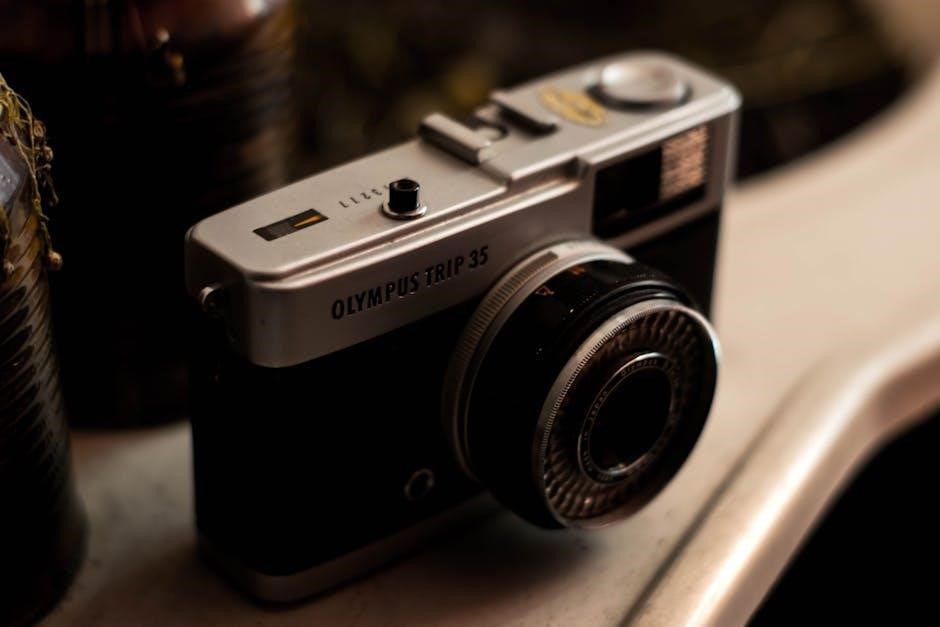
The Olympus XA2’s spot metering mode allows precise exposure readings from a small, centrally located area. This feature is invaluable when photographing subjects against bright or dark backgrounds, ensuring accurate exposure for the primary subject. To utilize spot metering, half-press the shutter button and observe the light display.
Remember to carefully select the metering point, focusing on the most important tonal area of your scene for optimal results. It requires practice to master.
Exposure Compensation
The XA2 offers exposure compensation to fine-tune the camera’s automatic metering. This is crucial when the camera’s meter is fooled by unusually bright or dark scenes. Use the +/- buttons to adjust the exposure, with + values brightening the image and ⏤ values darkening it.
Experiment with different compensation levels to achieve the desired look. Remember that exposure compensation affects the entire image, not just specific areas.
Flash Photography
The Olympus XA2 features a built-in flash, ideal for low-light situations or adding fill light. It automatically activates in dim conditions, but can also be manually controlled. For optimal results, understand the flash’s range and potential for red-eye reduction.
While the XA2 doesn’t natively support complex external flash systems, adapters may offer limited compatibility. Experiment with flash settings to achieve balanced and well-lit photographs.
Built-in Flash Operation
The XA2’s integrated flash automatically fires when the camera deems insufficient light is present, ensuring proper exposure. Users can override this by manually enabling or disabling the flash using the designated control. Be mindful of the flash recycle time, indicated by a light, before subsequent use.
For close-up shots, the flash may cause harsh shadows; consider using a diffuser or adjusting your shooting angle. Understanding these nuances will enhance your flash photography results.
External Flash Compatibility
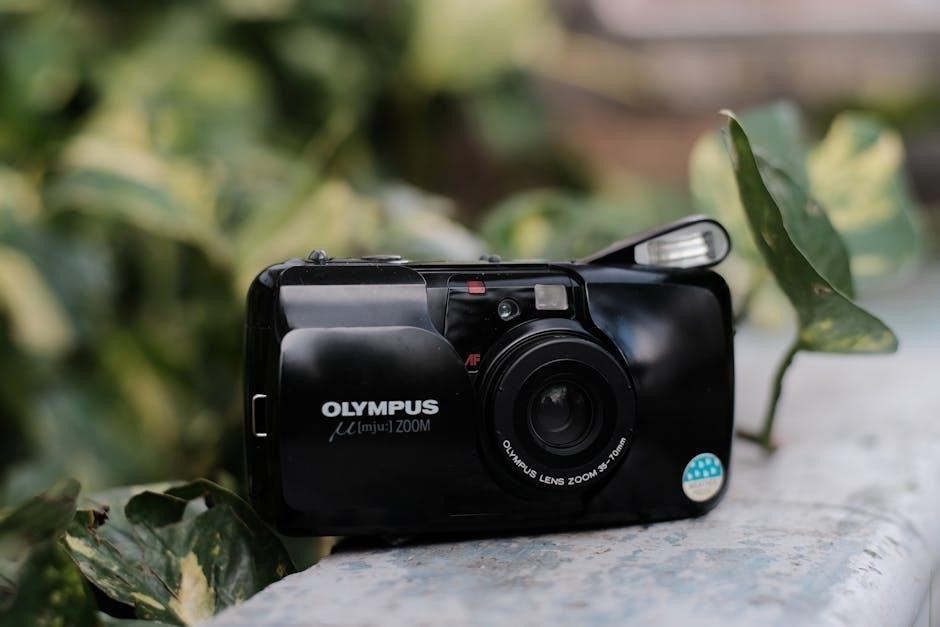
The Olympus XA2 features a hot shoe, enabling compatibility with various external flash units for expanded creative control. While specific compatibility isn’t extensively documented, standard hot shoe flashes generally function. Ensure the flash is set to manual mode for optimal results, as TTL functionality isn’t supported.
Using an external flash allows for greater light output and shaping possibilities, enhancing your photographic expression. Experiment with different flash settings and modifiers to achieve desired effects.
Advanced Features
The Olympus XA2 boasts a self-timer function, activated by a dedicated lever, allowing for self-portraits or delayed shots. Furthermore, it supports multiple exposures, achieved by holding the film advance lever after each shot, enabling creative layering effects.
These features, though simple, unlock significant artistic potential. Experimenting with these capabilities expands photographic possibilities beyond standard shooting modes, offering unique creative control.
Self-Timer Function
The XA2’s self-timer is activated via a dedicated lever located on the camera’s front panel. Switching this lever initiates a roughly 10-second delay before the shutter releases, providing ample time to compose yourself in the frame.
This feature is ideal for self-portraits or group photos where you need to be included. Remember to account for the delay when framing your shot, ensuring everyone is ready before activating the timer.
Multiple Exposures
The Olympus XA2 allows for creative multiple exposures, achieved by manually re-cocking the shutter after each exposure without advancing the film. This technique layers images onto the same frame, creating surreal or artistic effects.

Be mindful of overexposure; each subsequent image adds to the overall light. Experiment with different combinations and densities to achieve desired results, and remember to carefully consider your composition.
Troubleshooting Common Issues
Common problems with the Olympus XA2 include film advance issues, often due to a weak or failing mainspring. Metering errors can occur from a dirty or malfunctioning sensor, impacting exposure accuracy. Check the battery compartment for corrosion, as this can cause erratic behavior.
If the shutter doesn’t fire, ensure the film is loaded correctly and the battery is fresh. Consult online forums for specific solutions and potential repair options.
Film Advance Problems
Difficulty advancing film in the Olympus XA2 often points to a weakened mainspring, a common issue with older cameras. Ensure the film is correctly loaded, with the sprocket holes engaging properly. Check for obstructions within the film chamber, like torn film pieces.
If the advance lever feels loose or offers little resistance, professional servicing may be required. Avoid forcing the lever, as this could cause further damage to the delicate mechanism.
Metering Errors
Inaccurate readings from the Olympus XA2’s metering system can result in under or overexposed photos. Verify the battery is fresh, as low voltage impacts metering accuracy. Ensure the lens is clean, as dirt can interfere with light transmission.
Utilize exposure compensation to correct for challenging lighting situations. Consider the reflective properties of your subject; bright surfaces can fool the meter. Regular checks against a known good light meter are recommended.
XA2 vs. Other Olympus Cameras
Compared to the original Olympus XA, the XA2 offers improved controls and a slightly refined design. Unlike larger Olympus models like the OM-1 or OM-4, the XA2 prioritizes compactness and simplicity.
While lacking the extensive manual controls of the OM series, the XA2’s aperture priority mode provides creative flexibility. Modern OM-System cameras, like the OM-1, boast advanced features, but the XA2 remains a unique, capable film camera.
XA vs. XA2: Key Differences
The XA2 builds upon the original XA, introducing a hot shoe for external flash compatibility – a significant upgrade. While both share a similar clamshell design and aperture priority operation, the XA2 features a more prominent shutter button and improved grip.
Notably, the XA2 retains the XA’s excellent Zuiko lens, but offers enhanced usability. Users seeking external flash options will find the XA2 a preferable choice over the original XA.

Care and Maintenance
To ensure longevity, regularly clean the lens with a soft, lint-free cloth, avoiding harsh chemicals. Proper storage in a dry environment protects against mold and corrosion. Battery replacement should utilize compatible batteries, carefully observing polarity.
Avoid dropping or subjecting the camera to extreme temperatures or humidity. Gentle handling of all controls prevents damage. Regular checks of the battery compartment for corrosion are also recommended for optimal performance.
Cleaning the Lens
To maintain optimal image quality, regularly clean the Olympus XA2 lens. Use a soft, lint-free cloth—microfiber is ideal—and gently wipe away dust and fingerprints. Avoid using excessive pressure or abrasive cleaners, which can scratch the coating.
For stubborn smudges, breathe lightly on the lens to create condensation, then wipe gently. Never use solvents or household cleaning products. Proper lens care ensures clear, sharp photographs for years to come.
Battery Replacement
The Olympus XA2 utilizes a specialized battery; ensure you have a compatible replacement readily available. To replace the battery, locate the battery compartment—consult your manual for its precise location. Carefully open the compartment and remove the old battery, noting its orientation.
Insert the new battery, aligning the positive and negative terminals correctly. Close the compartment securely. Always dispose of used batteries responsibly, following local regulations.
Resources and Further Information
For comprehensive support, explore online manuals and dedicated forums like the Olympus Forum, a vibrant OM-System community. Numerous websites host the Olympus XA2 instruction manual in PDF format, offering detailed guidance. Orphan Cameras ([https://www.orphancameras.com/chinon/olympus/olympus_xa2/olympus_xa2.htm](https://www.orphancameras.com/chinon/olympus/olympus_xa2/olympus_xa2.htm)) provides a valuable resource.
These platforms facilitate knowledge sharing and troubleshooting assistance from fellow enthusiasts.
Online Manuals and Forums
Accessing the Olympus XA2 manual online is straightforward; several websites archive PDF versions for free download. Orphan Cameras ([https://www.orphancameras.com/chinon/olympus/olympus_xa2/olympus_xa2.htm](https://www.orphancameras.com/chinon/olympus/olympus_xa2/olympus_xa2.htm)) is a key resource. The Olympus Forum, a thriving OM-System community, offers invaluable support.
Engage with fellow users to discuss techniques, troubleshoot issues, and share experiences with this classic camera.

PDF Manual Download
Fortunately, a readily available PDF version of the Olympus XA2 instruction manual simplifies camera operation. Websites like Orphan Cameras ([https://www.orphancameras.com/chinon/olympus/olympus_xa2/olympus_xa2.htm](https://www.orphancameras.com/chinon/olympus/olympus_xa2/olympus_xa2.htm)) host this essential resource for convenient access.
Downloading the manual allows offline viewing and printing, ensuring guidance is always at hand during your photographic adventures with this iconic camera.